While student teaching at Valley Central High School, I had the exciting opportunity to lead the district’s college-level AP Art class. This course, run through College Central, allowed students to earn three college credits in art upon successful completion and submission of their final portfolio. Unlike a traditional high school art class with a set curriculum, AP Art challenged students to design their own learning experience. Each student developed what’s called a “Sustained Investigation” (SI), essentially a year-long artistic inquiry centered around a theme, question, or concept they wanted to explore. The goal was to show both conceptual depth and technical growth throughout the year. Rather than simply producing finished pieces, students were expected to document their creative process, reflect on their choices, and demonstrate how their ideas evolved over time. In addition to submitting their visual work, they also completed a written portfolio component where they explained their artistic decisions.
At first, I was admittedly intimidated. Each student was pursuing a completely different project, often in a different medium. One student even chose to create a 3D portfolio while others focused on traditional 2D work. Managing so many independent investigations felt impossible. However, as a college art student myself, I reframed my perspective and saw this as an opportunity. I reflected on my own high school art experience, where exposure to diverse contemporary artists and experimental materials had been limited, and decided to build a classroom structure that encouraged curiosity.
To do this, I developed a weekly rhythm that helped my students stay inspired and engaged. On “Material Mondays,” I introduced a new art medium or technique at the start of class, anything from gouache to printmaking, and students could choose to experiment with it for the remainder of the period. “Tuesday Muse” featured a contemporary artist each week, and I made a point to showcase creators from diverse backgrounds, including Black and LGBTQ+ artists, so that my students could see a wide range of perspectives represented in the art world. “What If Wednesdays” were devoted to creative prompts that encouraged self-reflection, for instance, students might respond in their sketchbooks to a question like, “What would your art look like if you weren’t afraid to make mistakes?” On “Group Think Thursdays,” students engaged in structured discussions, sharing challenges, offering feedback, and practicing the skill of speaking critically about their work. Finally, “Free Flow Fridays” served as an open studio day where students could immerse themselves in their projects without restrictions
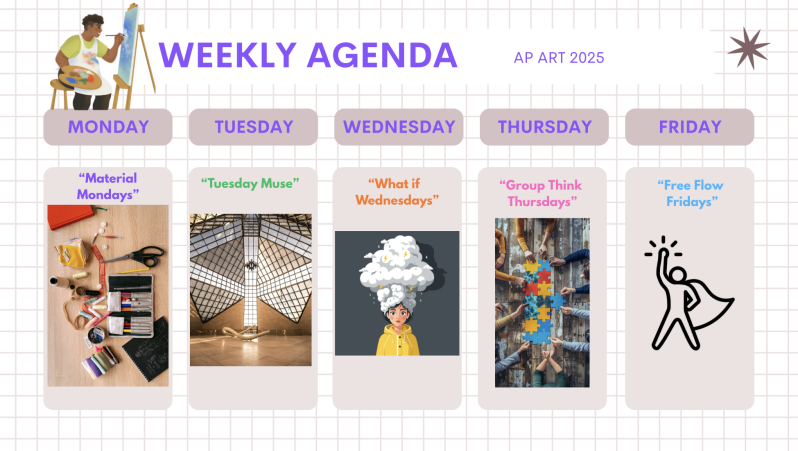
This weekly structure struck a balance between freedom and guidance, helping students maintain momentum while developing their unique artistic voices. The results were inspiring. Two students, for example, discovered gouache for the first time during a Material Monday session and decided to use it as their primary medium for their Sustained Investigations. Group Think Thursdays proved particularly transformative, over time, students who were initially nervous and hesitant to speak about their work became confident in presenting their ideas. Looking ahead, if I were ever to teach this class again, I would absolutely use a similar structure. It not only kept the students motivated, but also fostered a strong classroom community where creativity could thrive.
On my last day of student teaching at Valley Central, my AP Art students surprised me with a little farewell party. They had made beautiful, hand-drawn cards filled with kind messages like, “We love how you structured the class,” “We learned a lot,” and “I hope I’m as good of an art teacher as you are one day.” It was one of those moments that reaffirmed why I chose to become a teacher in the first place. That day, I left the classroom not just proud of their growth, but inspired by the potential of what art education can be when it empowers students to find their own voices.
Add comment
Comments